The Stages of Children's Art: What Your Child's Drawings Mean from Age 1 to 11
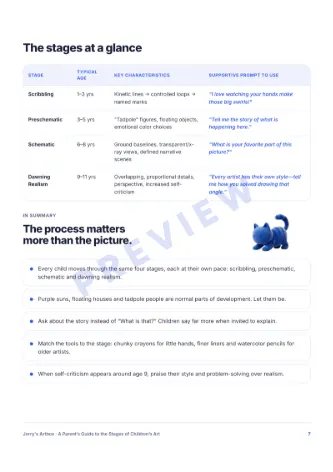
Most children move through the same broad stages as they learn to draw. Knowing them helps you see what your child is working on when a new drawing comes home, and know what to say. Ages are a rough guide: every child moves at their own pace.
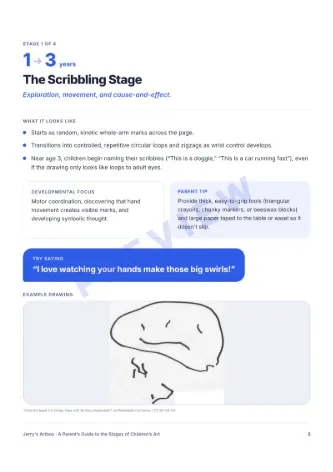
Ages 1 to 3: the scribbling stage
It starts with random, whole-arm marks, then becomes more controlled: loops, lines and zigzags. A big moment comes when children start naming their scribbles ("that's Daddy!"), even if you can't see it. They're discovering that marks can stand for things.
Give them thick, easy-to-grip tools, like triangular crayons, chunky markers or beeswax blocks, and big paper taped to the table so it doesn't slip. Try saying: "I love watching your hands make those big swirls!"
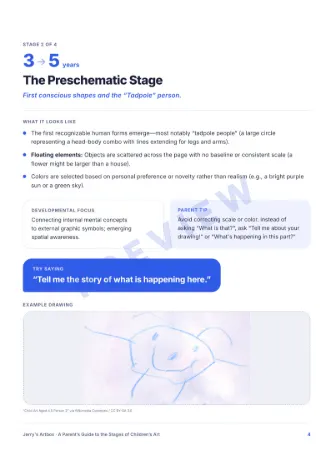
Ages 3 to 5: the preschematic stage
The first recognisable people appear, usually "tadpole people": a big circle for a head and body with lines for arms and legs. Things float around the page with no ground line or consistent size, so a flower can be bigger than a house, and colours are chosen for fun rather than realism, like a purple sun or a green sky.
Resist correcting the size or colour. Instead of "What is that?", try "Tell me about your drawing!" or "Tell me the story of what's happening here."
Ages 6 to 8: the schematic stage
Now drawings get organised. A ground line appears along the bottom, with a sky at the top. Children repeat their own symbols for trees, houses and people, and you'll often see x-ray views, like the inside of a house shown at the same time as the outside. Drawings tell stories.
Encourage the stories behind the pictures: "Where are they walking to?" or "What sounds do you hear in this picture?". A simple "What's your favourite part of this picture?" works well too.
Ages 9 to 11: dawning realism
Children start using overlap, depth and detail, and want their drawings to look real. This is also when many become self-critical and start comparing their work with real life. Gentle encouragement matters most here: focus on effort, ideas and style rather than whether it looks "right".
Showing them how different artists draw in very different styles can help too.
Want the full printable?
A Parent's Guide to the Stages of Children's Art gives each stage its own page, with example drawings, the skills it builds, a parent tip and a phrase to use, plus a one-page summary and two pages to draw together.