What Is Pixel Art? A Kid-Friendly History and Screen-Free Coding Challenges
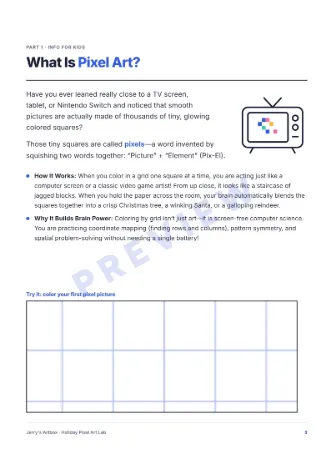
Lean close to any screen and you'll see that smooth pictures are really thousands of tiny glowing squares. They're called pixels, a word made by squishing together "picture" and "element". Colouring a grid one square at a time is exactly what a computer screen does, which makes pixel art a fun way into coding for kids aged 5 to 10.
Pixel art is older than computers
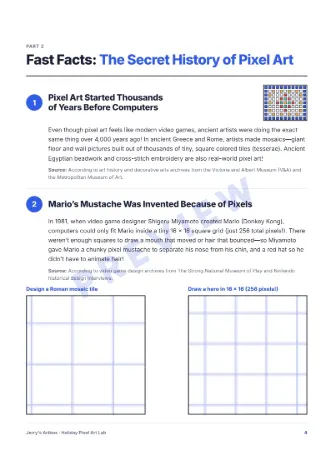
Artists in ancient Greece and Rome made mosaics, huge floor and wall pictures built from thousands of tiny square tiles called tesserae. Ancient Egyptian beadwork and cross-stitch embroidery work the same way.
In 1981, when Shigeru Miyamoto created Mario, the character had to fit inside a 16 × 16 grid, just 256 pixels. There weren't enough squares for a moving mouth or bouncing hair, so Mario got a chunky mustache to separate his nose from his chin, and a red cap so his hair didn't need animating.
In the 1980s, the artist Susan Kare designed the friendly icons on the first Macintosh computer, like the smiling computer and the trash can, by colouring in squares in graph-paper notebooks. And when you build in Minecraft, you're using 3D pixels, which game designers call voxels (volume plus pixel).
Why grid colouring is coding
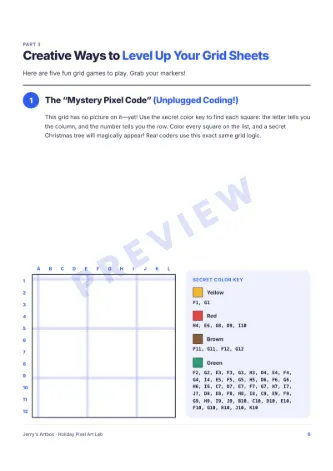
When kids follow a grid, they're practising coordinate mapping (finding rows and columns), pattern symmetry and spatial problem-solving, all without a single battery. A great first challenge is a mystery pixel code: a blank grid with a list of squares like F1 and G1 in yellow, where the letter is the column and the number is the row. Colour every square on the list and a hidden picture appears, using exactly the same grid logic real coders use.
Try a mirror challenge too: colour only the left half of a picture, then count squares to mirror it on the right. And here's a fun trick: tape a finished pixel picture to the fridge, walk ten steps back and squint. The chunky blocks smooth out into a sharp picture, just like a screen.
Want the full printable?
My Holiday Pixel Lab has a mystery code that reveals a Christmas tree, a mirror present, a 16 × 16 pixel Santa, ideas for turning grids into bead and brick crafts, a holiday emoji designer and three free pixel pages.