How to Explain Abstract Art to Kids (and Why They Often Get It Better Than We Do)
Many adults feel lost in front of abstract art because they're looking for something recognisable. Children don't worry about that: to a child, an explosion of blue lines is simply energy, mood and rhythm. Here are some stories to share, and a better question to ask.
Three stories kids love
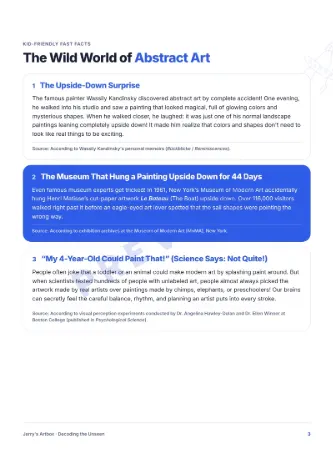
Wassily Kandinsky discovered abstract art by accident. In his memoirs, he describes walking into his studio and seeing a magical painting full of glowing colours and mysterious shapes. When he walked closer, he laughed: it was one of his ordinary landscapes, leaning upside down. It made him realise colours and shapes don't need to look like real things to be exciting.
In 1961, New York's Museum of Modern Art hung Henri Matisse's cut-paper work Le Bateau (The Boat) upside down by mistake. It stayed that way for 44 days, and more than 116,000 visitors walked past before someone noticed the sails were pointing the wrong way.
And "my four-year-old could paint that"? Not quite. In experiments by Angelina Hawley-Dolan and Ellen Winner at Boston College, people looking at unlabelled paintings mostly picked the ones by real artists over those made by children or animals. Our brains can sense the balance and planning behind the strokes.
Ask "What does it feel like?"
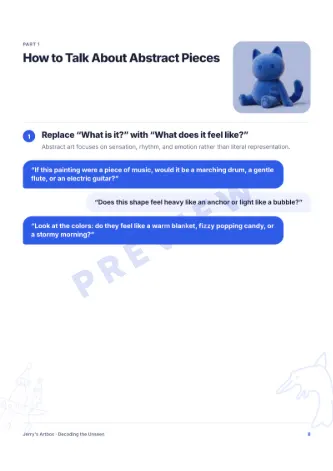
Swap "What is it?" for "What does it feel like?". Is it loud or quiet? Happy, angry or calm? Try tracing the artist's movements in the air with a finger: was the brush fast or slow? Notice the empty space, too. Why might the artist have left that part blank?
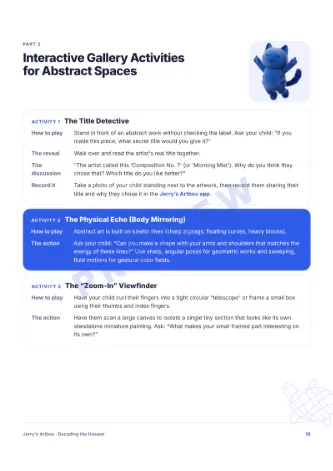
A fun game is the title detective: before reading the label, ask your child to give the painting their own title, then compare it with the real one. There are no wrong answers, which is exactly what makes abstract art such a confidence boost for kids.
Want the full printable?
Our abstract art gallery guide has more fast facts, the gallery rules explained for kids, three gallery games (Title Detective, Physical Echo and the Zoom-In Viewfinder) and two worksheets to fill in on the day.