How to Draw Comics: Tips Real Comic Artists Use, for Kids
Lots of kids want to make comics, and a few tricks from real comic artists make a huge difference. Here are some of the secrets of how comics work, and tips young creators can try straight away.
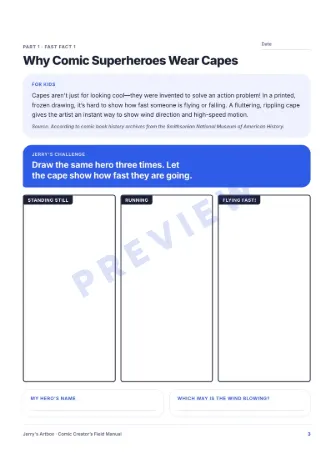
Why superheroes wear capes
Capes aren't just for looking cool. They solve a problem: in a frozen, printed drawing, it's hard to show how fast someone is moving. A fluttering, rippling cape shows the wind direction and the speed instantly. Try drawing the same hero three times, standing still, running and flying fast, and let the cape tell the story.
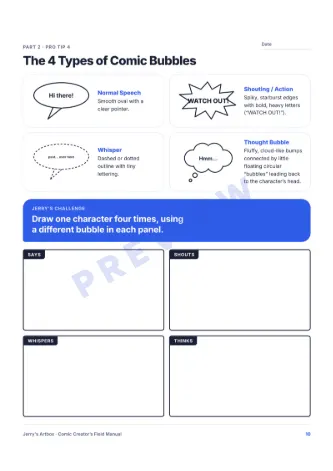
The four types of speech bubble
A normal speech bubble is a smooth oval with a clear pointer. A shout or action bubble has spiky, starburst edges and bold, heavy letters ("WATCH OUT!"). A whisper has a dashed or dotted outline and tiny lettering. And a thought bubble is fluffy and cloud-like, joined to the character's head by little floating circles.
Try drawing one character four times: saying something, shouting, whispering and thinking. It's a quick way to see how much a bubble changes the mood.
More tips from the pros
Write the words first, then draw the picture around them, so the bubbles don't end up squashed into a corner. Always point the bubble's tail at the person speaking. Vary your camera angles: a close-up for feelings, a wide shot to show where we are, a view from below to make someone look huge. And add motion lines behind anything moving fast.
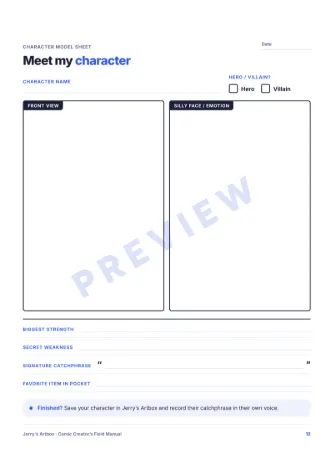
Before starting a longer comic, draw your main character on a model sheet. Real comic artists do this so the character looks the same in every panel.
Two more comic secrets
Before Batman or Spider-Man, one of the first popular newspaper comic stars was a mischievous bald boy in a huge yellow nightshirt, called The Yellow Kid, from 1895. He was so famous that people bought yellow buttons, cracker tins and toys with his face on them. Ask your child to invent their own comic star, then design the toys people would buy.
Look at an old comic book under a magnifying glass and you won't see solid colours, but thousands of tiny magenta, yellow and cyan dots, called Ben-Day dots. Old printing presses couldn't print every colour, so they placed dots close together and let readers' eyes blend them into new ones. Try it: fill a circle with red and blue dots only, then hold it far away and squint.
Want the full printable?
The Comic Creator's Field Manual has these facts and tips, each with a drawing challenge, a character model sheet, and four make-your-own pages: 3-panel strips, an action page, a 6-panel page and a blank layout.